
My children are no longer children, they are adults. I also left schoolteaching behind at the end of the 90’s to teach at university. These facts mean that I didn’t have to face up to the realities of navigating the impacts of social media use on young minds. There was no social media at the time. For that I’m grateful. Not that there weren’t other issues to deal with associated with technical developments – internet access, cost of data and mobile phones to count but a few. I remember having to justify choosing a phone for youngest son which was attached to a very uncool supermarket internet provider, struggling to explain how some online sharing was inappropriate for teenagers and all the resultant strops. Life as a parent can be challenging when the kids push for independance but are not yet able to appreciate the consequences of some choices…
And yet…social media became one of my main specialisms as part of my professional life from the early 2000s. My online identity as @warwicklanguage became a crucial part of my professional development over the ensuing years. I made many great friends and collaborators who I would otherwise never have discovered. I was not particularly risk averse as I navigated the new tools available, but I had plenty of life experience and was not afraid to block and report. Networks such as ALT helped me find my way. My overriding thought was the importance of being present online in order to help balance the more unpleasant interaction and provide safe and informative resources for others.
Then #enshittification happened.
I really feel for those who are having to deal with the complexity of parenting decisions in the current context. I appreciate the open internet brought many new opportunities to connect, collaborate, create and learn. Sadly the much hyped AI and the resultant drive from tech bros to raise more money, use more resources and resits all entreaties to improve their “products” have created existential threats to the lives of many young people and, even for adults, increased the manipulation of our attention to the extent that they present barriers to democracy and truth.
Yesterday’s social media ban announcement for under 16’s was greeted with mixed reactions. For many, especially those who have paid a high price for their child’s use of social media, the announcement was a long awaited signal from the UK that the largely unregulated social media industry has not done enough to keep under 16’s safe. However, I understand that parents of those who have grown up with social media as a playground and a largely positive experience will feel a ban just makes their life – and that of their child – harder. It is right that we hear their voices too, and that we offer safe and constructive experiences throughout childhood both online and in real life. This needs to be part of the pushback over coming months. Stronger networks are needed especially for those who are trying to support young people with additional needs. We must reach out and provide moral support and practical tips in person and online.
Nonetheless, a decision has been taken which may save some of the most precious experiences of childhood and encourage parents to help their young people become adults in a complex and dangerous world. Of course it is an imperfect decision and there is more work to do but a reality check for us all is needed in the face of the addictive nature of these “tools”. Governments are not really equipped to manage such challenges alone.
I am including two resources I found really helpful yesterday. The first is an extract from a piece by John Naughton (“the networker” from The Guardian)
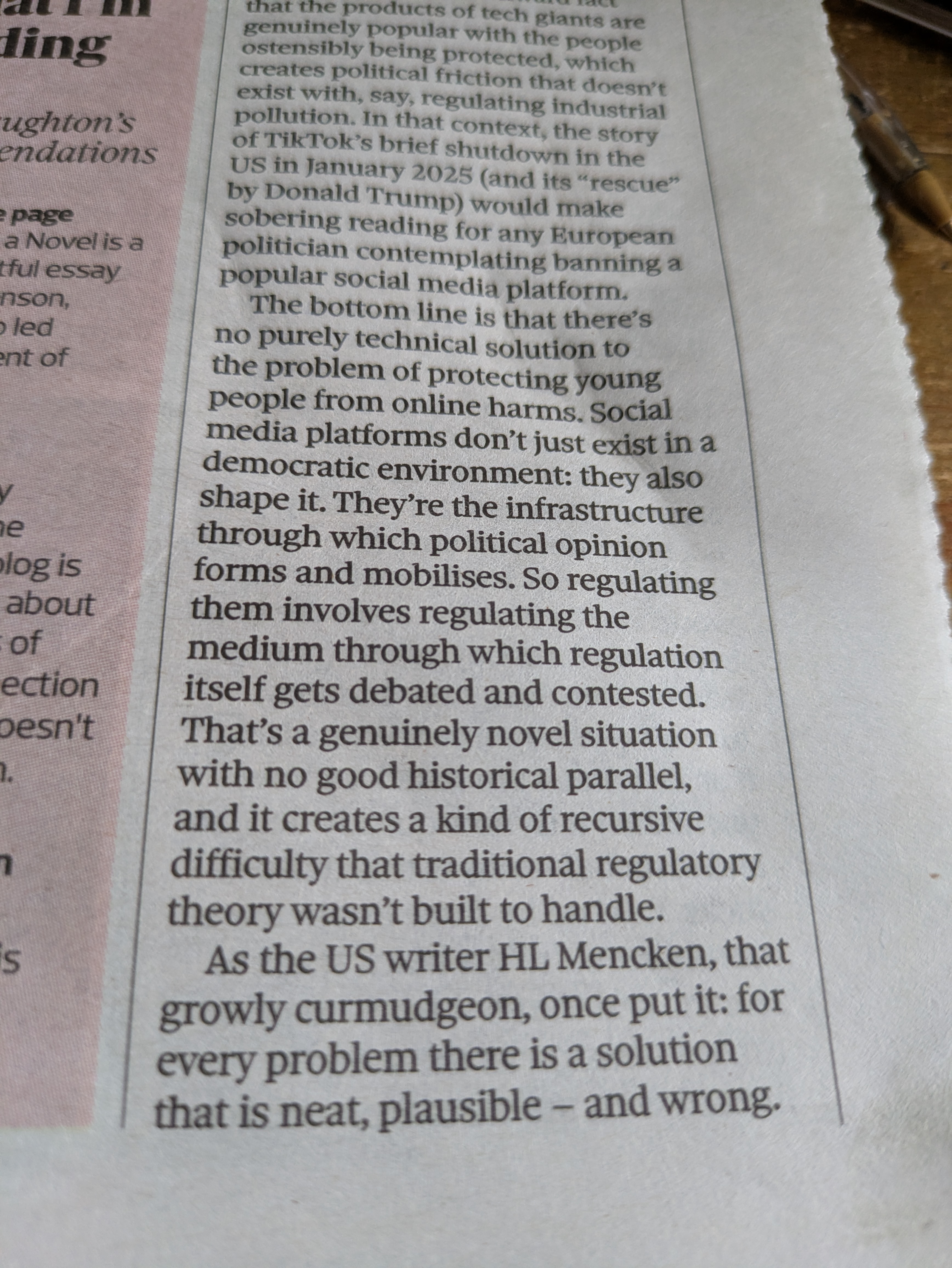
and this via Bluesky:

