
I am committed, despite my retirement, to continuing my learning and increasing my understanding of ed tech. It is an area of activity I have always found interesting and it dominated my professional identity for many years, long before ed tech was all about the digital domain. Now of course I find myself swimming against the rough currents of #AI and the normalisation of social media interactions across all aspects of life, including high level political exchanges between national leaders. Back in 2017 the ALT OER17 conference was held in London and I’m so grateful that I was able to attend as that community remains a lighthouse, a beacon of light to steer by. At the time we were all aware of the challenges which were facing both the UK and the USA, but I don’t think anyone really understood how quickly and how completely the world would change in less than 10 years.
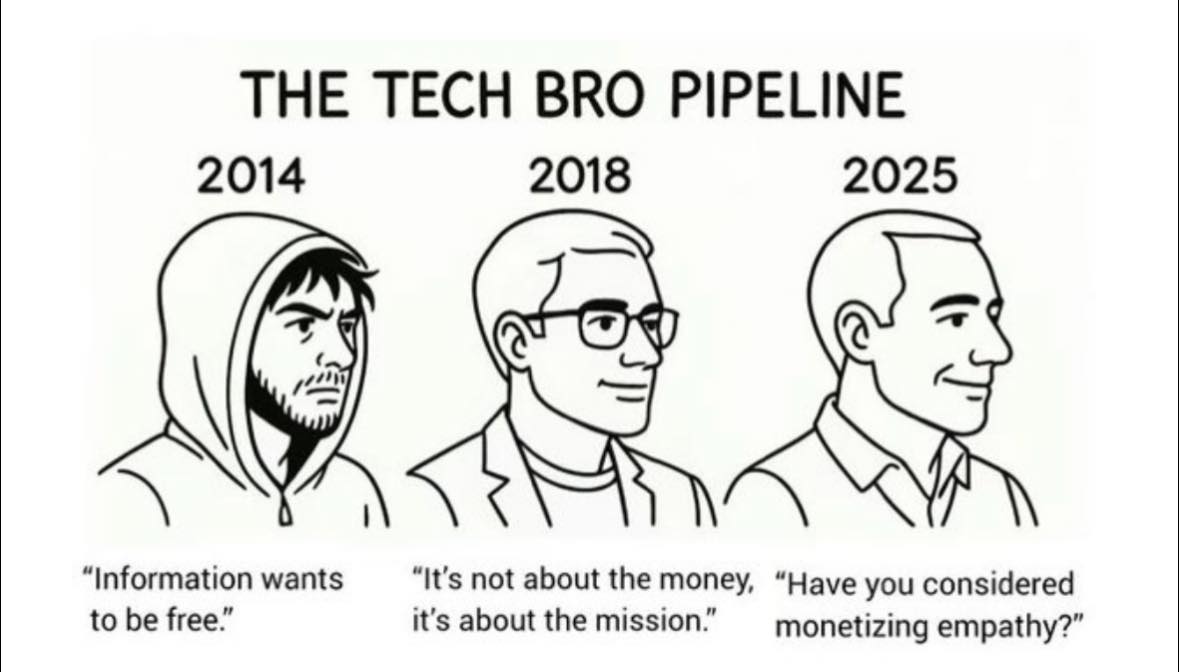
I recently acquired a new item of vocabulary to help pin down the source of my concern: the broligarchy (see pic above). My reading of this book (illustrated below) has opened my eyes to the world view of this particular élite – those who have ridden the wave of digital innovation and now, their wealth far beyond what most of us can comprehend, are shaping the world for the rest of us using all that they can influence and control.

So whilst I was working to master social media and understand the potential educational advantages of the rapidly changing IT infrastructure available to me, the “tech entrepreneurs” were growing rich and their focus was moving more towards their personal interests whilst their minions were left to “run the shop”. Adam Becker’s book showed me how the broligarchy had capitalised on their increased sphere of influence to further their own rather twisted, transhuman view of the future. I will summarise some of the key beliefs Adam illustrates very fully in his book with plenty of detail and analysis of interviews, chat room conversations etc with leading figures:
- Technology will continue to evolve at ever increasing speeds and provide the route to the salvation of humanity – towards the Singularity.
- All limitations (such as regulation, earth’s resources, global warming) can be ignored in order to support technological growth – Transcendance
- The goal of tech progress is AGI – the creation of a General Artificial Intelligence defined by them as “a machine that can reproduce any economically productive activity done by a human”
Although there are several schools of thought from the broligarchy and their circle regarding the future of tech, I sometimes found it really hard to stomach the underlying philosophies put forward by these (mainly white male) techies. Having spent many years teaching adolescents and having raised 2 boys myself I found myself looking into the “souls” of these wealthy men and disliking what I saw. Self-centred privileged people who saw those who share their planet as just insignificant, unintelligent beings who could be pawns to be exploited in the race to achieve their goals. Surrounding themselves with “yes men” they don’t tolerate challenge or consider views which come from experts in any area other than their rather rarified area of operation. Mysogyny and racism are endemic to their discourse, groupthink is rampant. Becker suggests they would benefit from a liberal arts education, I agree and found this video interview helpful. In reality most of them have opted out of higher education studies to focus instead on their entrepreneurial activities and the persuit of extreme, brutal capitalism. They pride themselves on “their” achievements, ignoring the fact that the industry had benefitted (and continues to benefit) from huge investments from government(s).
Techbros make very poor use of language. OpenAI for example is certainly not open in the sense that the open education community could accept. Effective Altruism (EA) an organisation formed to channel money into pet projects espoused by these billionaires is certainly not altruistic, it is only effective in supporting the unchallenged biases of this elite group. Its political influence extends into the UK as advocated by Dominic Cummins. Longtermism is used to justify any damage that may be done during the persuit of the perpetual growth of technology they require.
In concluding his book Becker says we should not be too hard on these men and I found myself feeling sorry for them (in the way I have in the past felt sorry for the disruptive pupil who fails to understand the damage they are doing to themselves) as they clearly have many neuroses:
-A fear of death which leads them to believe that immortality is possible if we just throw enough computing power at the problem. Their solutions fail to take account of flawed assumptions and show no awareness of history.
-A lack of empathy for and appreciation of the lived experience and expertise of others,making them the very opposite of “rounded human beings”. I wonder about the quality of their relationships.
-A failure to accept the value of life on earth which derives from the fleeting nature of life itself. I feel Camus would have much to teach them about absurdité and révolte. Colonising space is an attempt to distract from the responsibility of adressing the demands of life on a planet whose resources they endlessly consume.
However, how can I countenance continued activity which would support their aims and unpleasant future of a permanent plutocracy?
Any human power can be resisted and changed by human beings (Le Guin)
Fortunately I am able to draw on the insights of those I know through the open education community and beyond to see alternative futures which I can espouse.
Helen Beetham offers her detailed insights into AI in education here and I found her conversation with Doug Belshaw very interesting on her podcast.
Audrey Watters provided a really clear link between the fraudulent belief in IQ and the techbros myth that education is improved through use of technology.
Of course I understand educators and students feel the need to be aware of changes in technology and even to experiement. I just ask that we all be more aware of what we sacrifice in order to buy in to the techbro vision. Baxter concludes that the future is open – by this he means it is still possible to raise our voices and reject the vision of future presented by the broligarchy. I believe the open education community has a big part to play in that pushback, opening the eyes of others to the falacies we see coming from the tech industry. Just today I read this from Maha Bali.
“We may have democracy or we may have wealth concentrated in the hands of a few, but we can’t have both”
Louis Brandeis.
 Espace Sisyphe